

Today, AI Is Omnipresent in All Areas of Life
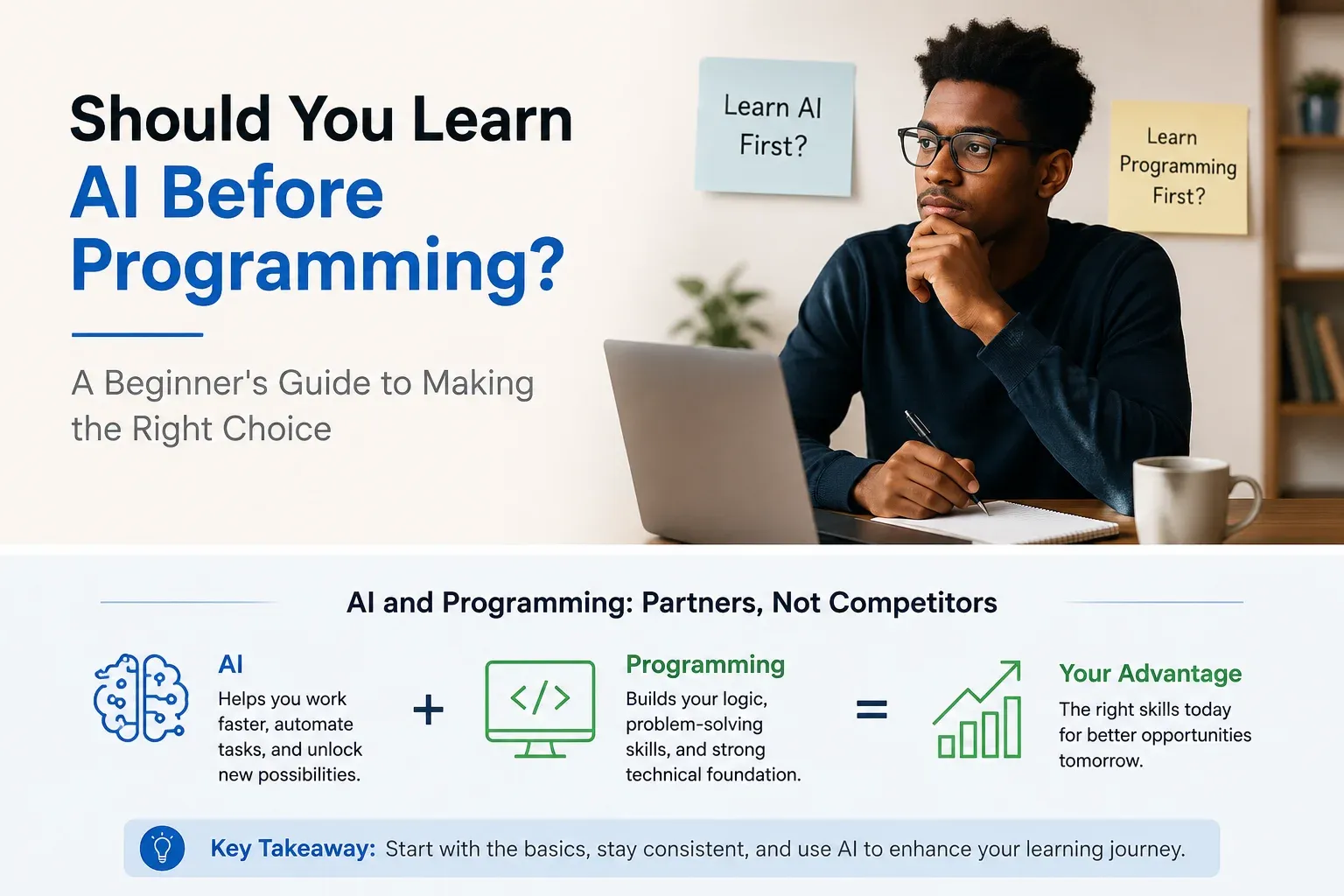
When users of social media want to do that with either their smartphone or computer, AI is most likely creating websites, apps designed by ChatGPT, and automating every routine for them all as quickly as possible and at a minimum this makes perfect sense. It’s an exciting experience. But for most, it also brings up a new question: Is it better I study AI before I work on anything else, or programming first?
That’s not a bad question; after all, AI tools seem to code, answer tech questions, and — at the most extreme end of the spectrum — build very simple applications. The short answer? For that, it depends on your goals. If you want to become a software developer, AI engineer, or machine learning expert, starting with programming will help you develop confidence much more. You can then do some research, which will allow you to use AI for productivity, content creation, or even to automate tasks without having to start over in the form of a programmer. Let’s break it down.
Why This Question Never Had Been the Same
Five years ago, almost every tech buff started their tech adventure by learning HTML, Python or JavaScript. Even now most beginners are taught AI before the time of writing the code. Tools like ChatGPT are producing websites, diagnosing software issues, writing emails and solving programming problems in just two or three seconds. ‘If AI can write code, don’t I necessarily need to learn programming?’ The response should not be binary: Yes or No. AI is changing the way humans work, but it hasn’t taken the place of the necessity of mastering the technology.
What Programming Actually Gives You
They tell you that programming is just learning a Python and JavaScript language. The truth is, making code takes much more than that. It teaches you how to think. As you learn code, you begin to:
- Take large problems and break them down into manageable sections.
- Think logically.
- Mark mistakes and remedy them.
- Build an incremental but sure series of solutions, bit by bit.
- Develop patience when things aren’t working the first time.
These are things that they will be good at for making websites, developing apps or managing AIs. Programming isn’t simply doing code. It’s about learning how to solve problems.
NovaBaze Insight 💡 AI is now able to write code in seconds. Knowing programming, you know if that code is error-free, safe, and solves your problem. And if you are more techy, you will be more comfortable with AI — and you won’t be in competition with it.
When It Makes Sense to Learn AI Before Everyone Else
Nowhere will you need to learn programming principles from the beginning. If your goal is to:
- Write better emails.
- Make better marketing copy.
- Generate ideas.
- Summarize documents.
- Improve productivity.
- Automate basic tasks.
- Create presentations.
Learn how to use AI tools today. In business, education or health care: many people today without any coding on the fly as they write or on computer screens have AI.
When Programming Comes Before Technology
If you dream of becoming:
- A Software Developer.
- A Web Developer.
- A Mobile App Developer.
- A Data Scientist.
- An AI Engineer.
- A Machine Learning Engineer.
Your beginning should be in programming. This establishes the cornerstone of understanding the why and how of AI models, how data functions, and how to create intelligent applications. If you have no foundation of that kind, using AI becomes much more difficult since you can’t do much more than generate basic prompts.
Why Is Python Still the Best Startpoint?
Even if you don’t know where to begin, Python remains one of the best programming languages to begin with. It’s popular because:
- The syntax is easy to read.
- You’re going to find it’s got a massive learning community.
- The code has extensive usage in AI and machine learning.
- Web development, automation, and data analysis are based on it.
- There are now thousands of free learning materials on the web.
Python doesn’t mean you are missing AI. That means you are preparing to use AI more wisely moving forward.
The Better Schooling Place for New Beginners
Don’t choose between AI and programming. Instead of choosing between AI and programming, view them as partners. Here is one possible feasible roadmap:
- Step 1. Programming Basics with Python.
- Step 2. Create easy automation tools, or calculators and quizzes.
- Step 3. Learn Git and GitHub to maintain organization in projects.
- Step 4. Utilize AI tools to assist with your workflow and coding issues.
- Step 5. Once you’re comfortable with the basics of programming, you should also get into machine learning, APIs, and AI development.
Such ways create confidence without overloading.
Do Not Let AI Be a Step Fatten Up
One mistake many early adopters make is expecting AI to solve every programming problem. This may sound like progress at first. But after a while, people are going to realize that they don’t know what the generated code done by AI is going to look like.
A more reasonable approach would be to consider AI a learning accomplice:
- Ask questions.
- Request explanations.
- Compare different solutions.
- Test the code yourself.
It is not to do all the work. The goal is to learn from it.
What Many Newbies Get Wrong
As programmers, you feel we will get replaced by AI. That’s not the full picture. AI is altering what it means to build software, but developers still must be capable of understanding requirements, designing systems, reviewing code, troubleshooting issues and decision-making. The powerful assistant is gaining ground: in most cases it’s no longer the replacement in companies. And the ones who actually benefit from this are both the programmers and users of AI itself.
Beginner Learning Checklist
Before diving into AI topics, think first:
- ✔ Have I learned variables, loops, and functions?
- ✔ Do I have at least three small programming projects?
- ✔ Can I describe what my code does without totally turning to AI?
- ✔ Do I use AI to learn instead of merely copying the answers back?
- ✔ Am I solving real problems instead of collecting tutorials?
If you answered “yes” for most of these questions, then you have laid a solid foundation.

