
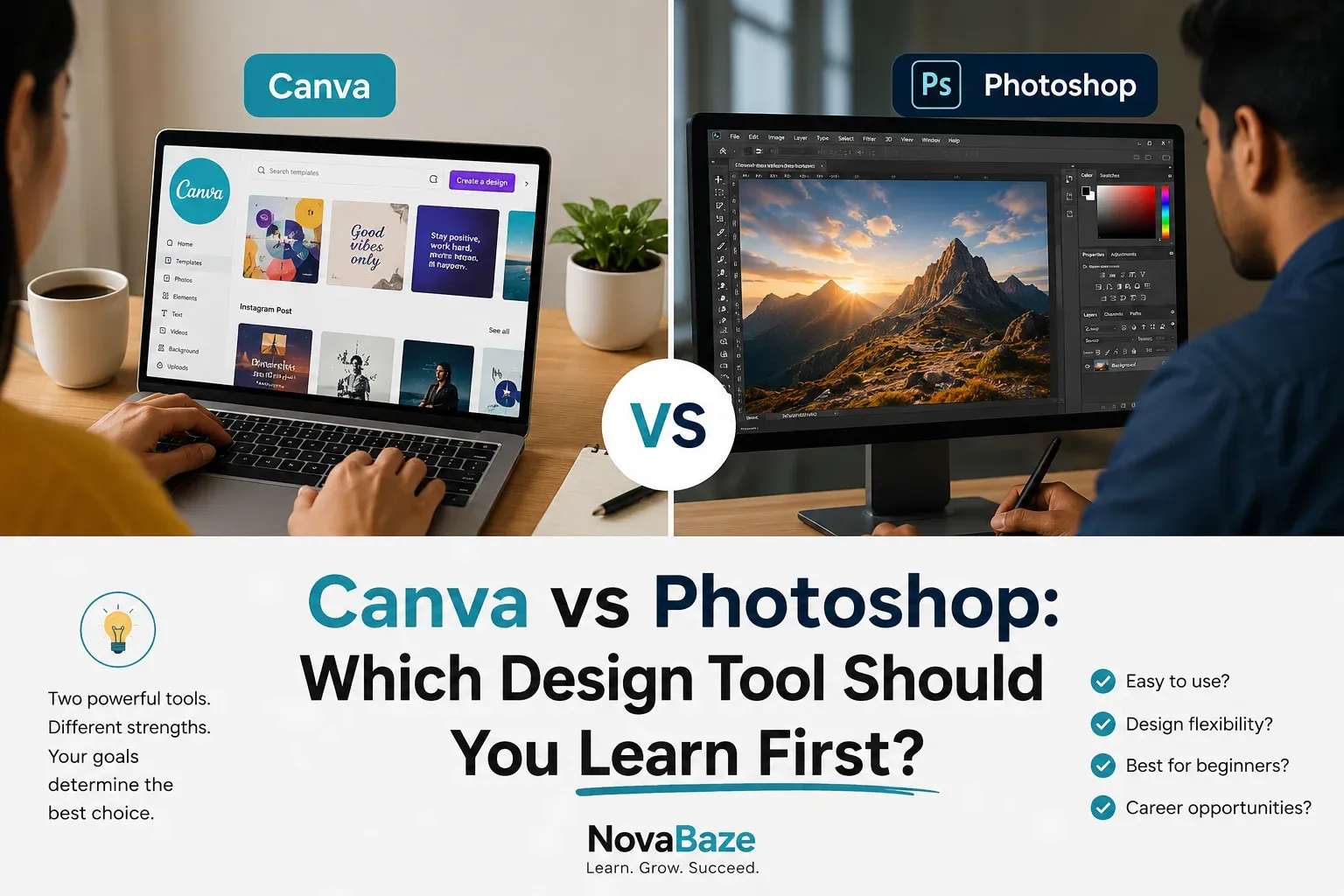
You know two popular names: Canva and Adobe Photoshop. Both are good design tools but were built in different ways! That often leaves those at the entry level confused: Will it eventually be Canva or Photoshop? And when it comes to it, the answer is not specific; it is a function of what you wish to build and your long-term objectives. Not everyone needs to be a computer graphics architect, some people just need an easy way to do daily design, and some want to be full-time graphic designers. This guide will be comparing Canva and Photoshop so that you can reach a decision between the two to see which one will suit you better.
What Is Canva?
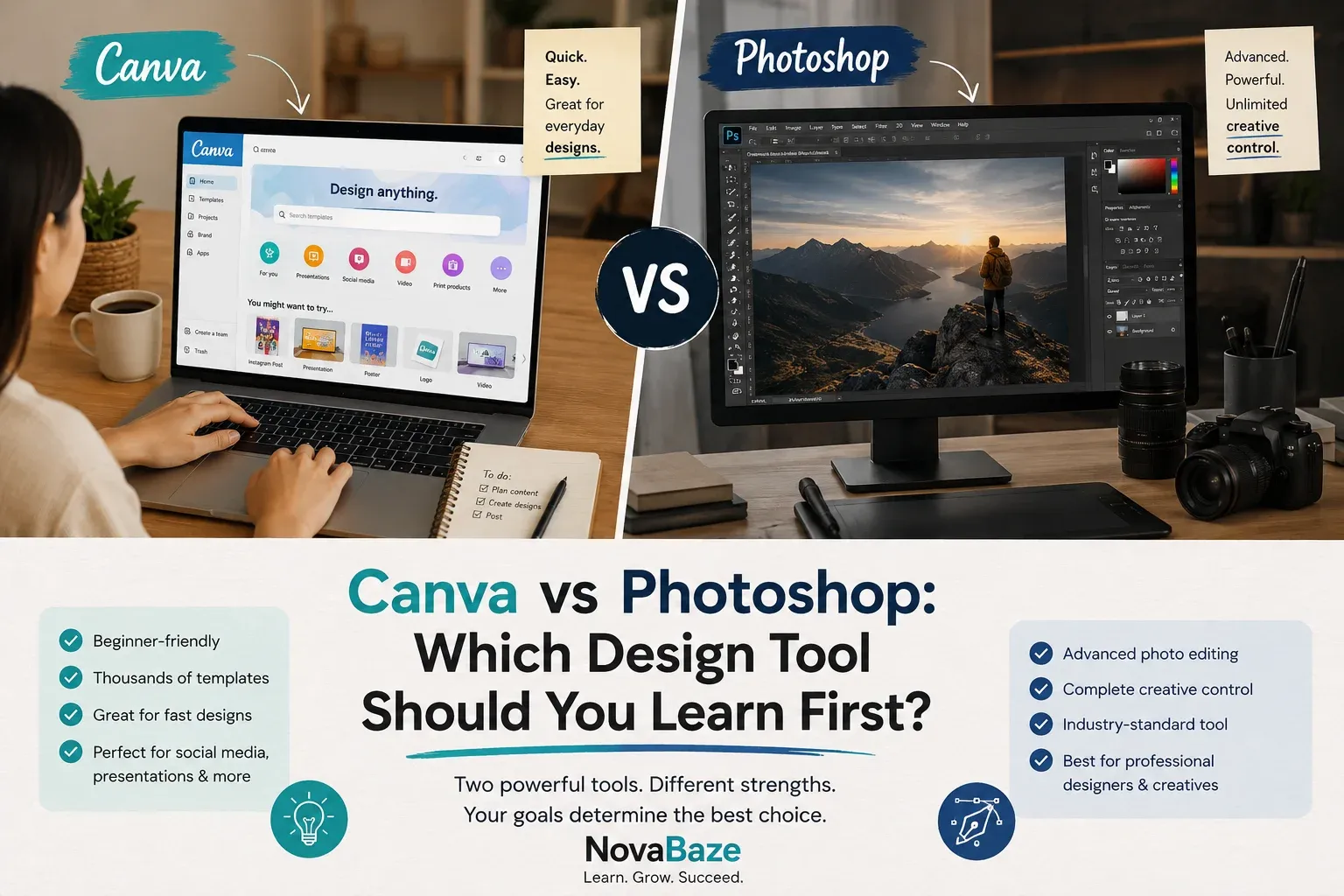
Canva is a totally different kind of online design platform designed to make designing graphic design more straightforward for all design styles, and you just can’t do that yourself. With a drag and drop style, users can design pretty things without needing a very good designer. It’s widely used by:
- Students
- Teachers
- Small business owners
- Freelancers
- Content creators
- Social media managers
If you’ve ever created a flyer, presentation or an Instagram post with a template, you’ve done work that Canva is meant for before.
What Is Photoshop?
Photoshop is a professional visual editing tool widely used by photographers, graphic designers, digital artists and digital creative professionals across the world, including agencies. With Photoshop, unlike Canva, everything about your design is your own. You can:
- Edit photos
- Remove backgrounds
- Create digital artwork
- Design posters
- Build marketing materials
- Retouch images
- Create advanced graphics
Photoshop has better features and powerful tools than Canva: That means Photoshop really does have more features so it is also a far more challenging tool to learn compared to Canva and a much more challenging tool than Canva.
NovaBaze Insight 💡
You are not allowed to say that Canva and Photoshop are more “better than” anything in that one another. The best tool is the tool that moves you closer to your goal. Select your own approach to designing not pick one tool that is more common on the default.
Ease of Learning
Canva helps beginners learn much easier. Build your first design in only five minutes. Photoshop, in contrast, requires more patience. You have to get layers and masks, selections, brushes and editing tools. Canva has a more gentle start for novices — and those new to designing.
Design Flexibility
And for setting up templates or just more basic graphics, Canva is where it’s the best. For entire design solutions from scratch, Photoshop works best. It also lends you much deeper control over both image preprocessing and photo editing and creative flourishes. If you need to go into professional graphic design, Photoshop has many other opportunities.
Best Uses of Canva
Canva is ideal for the following reasons:
- Social media posts
- Presentations
- School projects
- Flyers
- Certificates
- Invitations
- Business cards
- Simple logos
- CVs
- YouTube thumbnails
You know it’s for fast and convenient.
Best Uses for Photoshop
Photoshop is better suited for:
- Professional photo editing
- Brand identity design
- Advertising graphics
- Product mockups
- Digital painting
- Advanced image manipulation
- Print materials
- Creative artwork
Photoshop provides the tools professionals rely on, if precision matters.
Cost
Canva is also a free app, with thousands of templates, images and design software. Users needing other features get a Canva Pro upgrade. Photoshop subscriptions are available to an Adobe user. You will pay, but its professional features serve designers for commercial use.
Which is Better for Freelancer?
You can make money off both of them. Canva lets many freelancers start doing the following work:
- Social media graphics
- Church flyers
- Business promotions
- Presentations
- Marketing materials
Photoshop is often a good choice for:
- Professional branding
- Logo design
- Photo retouching
- Advertising campaigns
- High-end client work
The clients you want to serve should shape your decision.
Can You Learn Both?
Absolutely. In fact, enough successful designers do. If they have the time to do quick posts of content, but want their work to be on paper — they go to Canva. When projects require greater creativity and accuracy, they go with Photoshop. But if you learn Canva first, then moving to Photoshop won’t seem so insurmountable—you’re already familiar with how to do basic design by the end of your initial lesson on the principles of design like size and spacing, composition, color, or typeface design.
Things that Beginners Most Likely Get Wrong
So many beginners believe Photoshop automatically prepares a professional designer. That’s not true. It doesn’t define professional design. The software does not define professionalism. It relies on your understanding of design principles, creativity and your ability to express ideas clearly. But an adept designer can play comfortably with either tool.
Comparison on Canva vs Photoshop
| Feature | Canva | Photoshop |
|---|---|---|
| Friendly beginner | ✅ Very good | ⚠ Must practice |
| Photo Editing | Basic | Advanced |
| Templates | Thousands | Limited |
| Image Editing | No | Yes |
| Social Media Design | Great | Great |
| Learning Curve | Easy | Moderate To High |
| Free Version | Yes | Trial only |
| Best For | Everyday design | Professional creative design |
Final Thoughts
If you are also a bit new to graphic design, Canva will work as an entry-level tool. It enables you to learn the fundamentals without being deluged with technical tools. Photoshop also gives those who seek to make graphic design, photo shoots or digital art careers a lot of practical insight. This is a happy thing. You don’t have to choose one. Many designers use Canva (for fast turnaround or complex design), probably with lots of experience. They go with Photoshop. It’s not what software you pick, it’s the time you invest as you rehearse, tighten your craftsmanship and take control of your creativity.

