
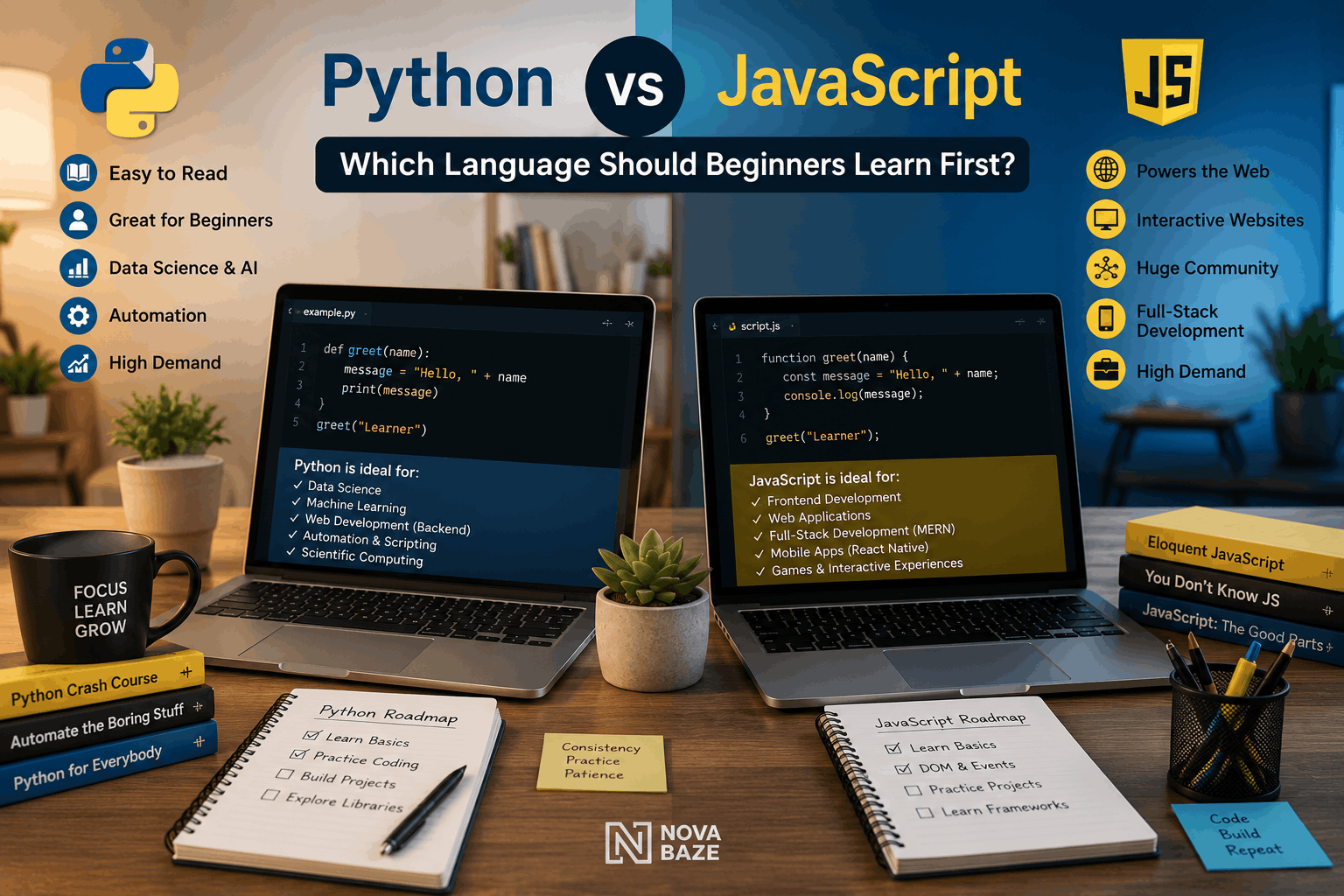
You’re thinking about learning programming; you’ve probably heard the same rule over and over: “Learn Python.” Then someone else retorts, JavaScript is better. JavaScript enables the web. Which one is really right? Yes, they are both fantastic programming languages, but approach different problems. The right language for you has less to do with what “better” one is than what you need to construct. Feel free not to worry if you get trapped between Python and JavaScript. By the end of this guide, you’d do well knowing where to begin.
First Things First: There Is No Wrong Choice
A lot of newcomers take weeks to figure out the best programming language before finally writing a line of code. That’s a mistake. Older developers will tell you that your first language is that language that you learn to think like a programmer. When you become familiar with code, learning new languages becomes infinitely easier.
So instead of Which is better? ask yourself: What do you want to create? Typically that question will always get you the right answer.
What is Python?
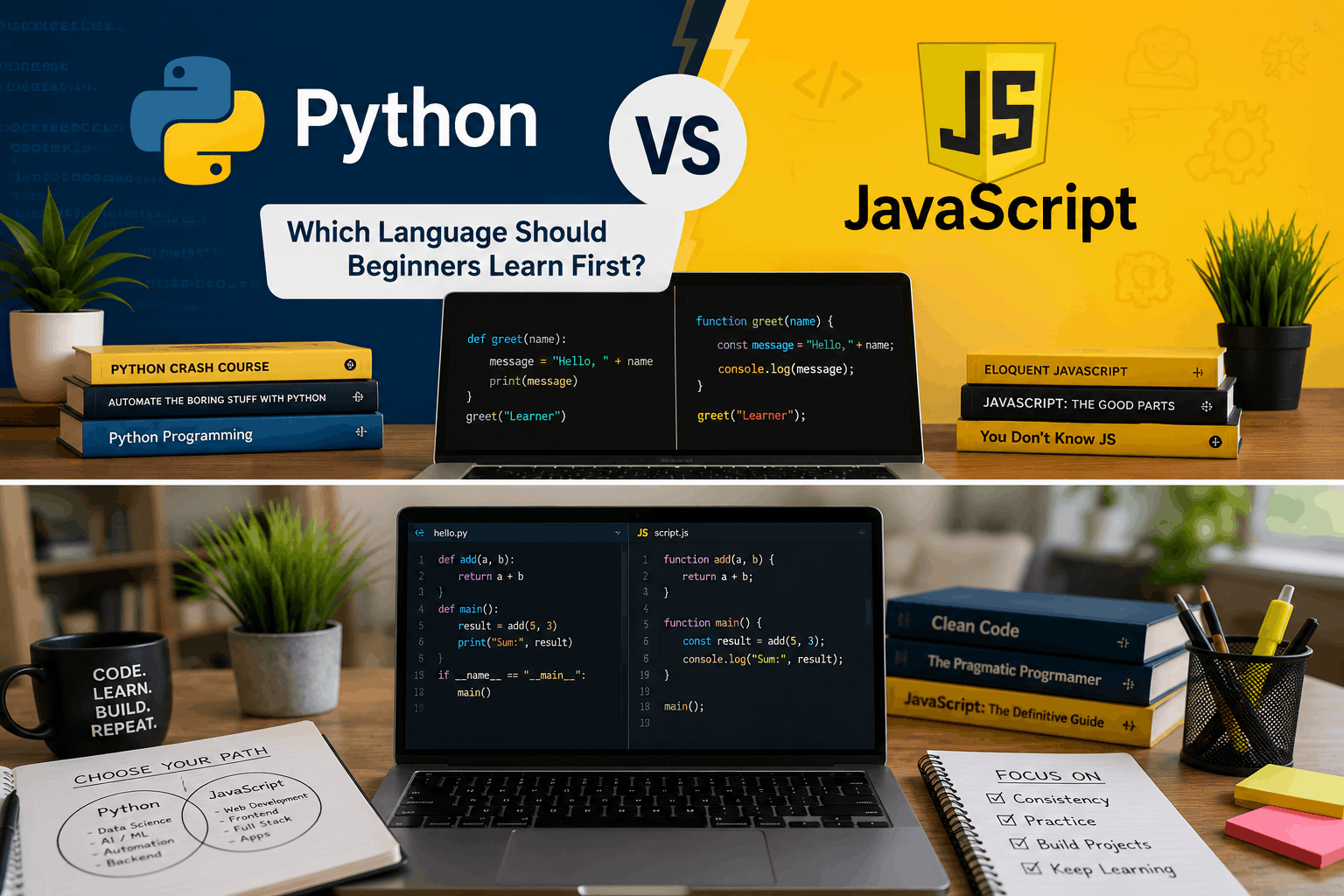
Python is one of the easiest programming languages to read. Its syntax is clean and simple, so beginners won’t worry so much about punctuation and will need a clearer picture of programming logic. Here’s a simple example:
name = "Samuel"
print("Welcome,", name)
Even though you’ve never programmed before, you can now probably guess what that code does. That’s perhaps another of Python’s greatest strengths.
What Is JavaScript?
JavaScript is the language to help bring websites to life. If you push a button to perform anything, click a form, view a form or watch animations or interact with a webpage, JS is probably running in the background. This is an example:
let name = "Samuel";
console.log("Welcome, " + name);
Not as hard as it is Python-wise, but since JavaScript was created specifically for other purposes, more terminology is required for users who are still getting used to the language, so those who want to learn it quickly later do that.
Python Vs JavaScript at a Glance
| Feature | Python | JavaScript |
|---|---|---|
| Beginner-friendly | ⭐⭐⭐⭐⭐ | ⭐⭐⭐⭐☆ |
| Easy to read | ⭐⭐⭐⭐⭐ | ⭐⭐⭐⭐☆ |
| Web development | ⭐⭐⭐☆☆ | ⭐⭐⭐⭐⭐ |
| Artificial Intelligence | ⭐⭐⭐⭐⭐ | ⭐⭐☆☆☆ |
| Data Science | ⭐⭐⭐⭐⭐ | ⭐⭐☆☆☆ |
| Mobile Apps | ⭐⭐⭐☆☆ | ⭐⭐⭐⭐☆ |
| Game Development | ⭐⭐⭐☆☆ | ⭐⭐⭐☆☆ |
| Job Opportunities | ⭐⭐⭐⭐⭐ | ⭐⭐⭐⭐⭐ |
The reality is that neither language is “winning.” They merely do a better job on different counts.
Choose Python If…
If you’re interested in:
- Artificial Intelligence.
- Machine Learning.
- Data Science.
- Automation.
- Cybersecurity.
- Scientific Computing.
- Beginner-friendly programming.
Most higher education now uses Python as they want to introduce programming because they can concentrate on learning logic without the hassle of complex syntax. What you need is the Python programming language if you like to see some solutions or problem solve or work with data.
Choose JavaScript If…
If your dreams are to create websites or web applications, JavaScript should probably be your first language. The program will aid you to establish:
- Interactive websites.
- Online stores.
- Dashboards.
- Web applications.
- Browser games.
- Modern user interfaces.
JavaScript’s most obvious benefit is that you can see your work instantaneously in a web browser, which many novices find inspirational.
Which Language Can You Learn the Course Easily?
Python tends to skew biased towards the beginner. The code seems cleaner, there are fewer lines to do several standard chores. Not to say JavaScript isn’t hard — it just exposes the average person to some of the things we know and think of as some kind of a weird language.
Please note that programming is not a black box in any country. The biggest challenge is not Python or JavaScript but gaining a practice of reasoning and solving logical problems, progressively.
What About Job Prospects?
This is what strikes most early computer programmers. And by far the most popular languages are Python and JavaScript. Companies hire Python developers for:
- AI projects.
- Data analysis.
- Backend systems.
- Automation.
- Cybersecurity.
JavaScript developers are used to build:
- Websites.
- Web applications.
- E-commerce platforms.
- Front-end interfaces.
- Full-stack applications.
And you won’t mess up either one from a career perspective.
Can You Learn Both?
Yes — and many developers do. Sure, most programmers learn one language, and then add another one. And this might be a simple way to learn:
- Learn Python or JavaScript.
- Build a few small projects.
- Know programming basics.
- Learn Git and GitHub.
- Look into a second programming language.
By then, the second language feels much simpler to learn, so much of the basic programming is done.
I would probably suggest Python if you asked me a language I would like to learn and didn’t communicate what I want to do. Not that it’s better, but it’s easier to read and far more often it makes beginners feel more confident sooner.
However, if someone says: “I’d like to be a web developer.” Then I would not hesitate to recommend JavaScript.
So a nice language — which is not the one with the most features, it’s the one that builds the things you’re excited about.
Final Thoughts
One of programming’s biggest and most pernicious myths is that the “wrong” first language will ruin your career. It won’t. What slows people down is spending months on comparative language practice when a person in fact is not learning a single language.
No matter how you wish to use it (Python or JavaScript) you’ll learn how variables work, how loops solve repetitive tasks, how functions structure your code, and how it is taught to think a problem through in a logical method. Those abilities are cross-pollinated between languages.
So pick one, open a code editor and start building simple projects, little by little. Six months from now, you won’t still have worries about what language you picked—what you want, next.

